The Kalakshetra Foundation proudly stands on Chennai’s coastlines as a testament to the country’s art and culture. A shrine to artistic endeavor, as the name implies. The institute was established in 1935 by Rukmini Devi, her brother Yagneswaran, and her husband Dr. George Sydney Arundale. Its modest beginnings took place in the Theosophical Society, Adyar, under a banyan tree. Dedicated to the preservation and development of ancient Indian arts, including Bharatanatyam, Carnatic music, and traditional crafts, it is one of India’s most esteemed institutions. The present campus, constructed in 1962, is a stunning fusion of architecture and nature that embodies Rukmini Devi’s philosophy of unity and nature-based learning. The foundation’s architectural vocabulary includes open performance spaces, natural materials, and a symbiotic relationship with nature.

Campus layout

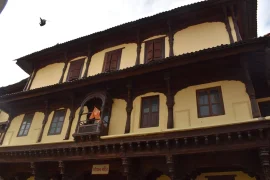
Located on a hundred-acre plot of land in the coastal area of Thiruvanmiyur, it was intended and created by Rukmini Devi as a self-contained cultural and educational center. Reminiscent of the old-fashioned Gurukula system, the layout fosters a strong relationship between students and teachers while providing residential facilities on campus. Academic, performance, craft, and residential areas are separated into distinct zones joined by open courtyards and shaded pathways. The Koothambalam, a Kerala-style wooden theater for small plays, and the Bharata Choodamani Auditorium, the main performance space, are well situated for easy access. These performance areas are surrounded by dance and music classrooms featuring open verandas. The northern section is home to the Craft Education and Research Centre, with workshops along the courtyards, as well as the Rukmini Devi Museum, which displays archive documents in a Chettinad-style structure. The western part is occupied by residential quarters and administrative blocks, with tiled-roof dormitories and the Jnana Mandir spiritual center. In addition to the extensive tree canopies that border the linking paths, lotus ponds, gardens, and a central banyan forest serve as an ode to the foundation’s original location. These trees act as a buffer for the noise, providing a serene atmosphere.
Design features: Classrooms

Designed as individual cottage-like structures, the classrooms of Kalakshetra feature individual plinths, red oxide flooring, and sloping roofs. They are roughly of two sizes, 8 m x 4.5 m and 10 m x 7.5 m, with large windows and high ceilings that facilitate cross-ventilation and abundant natural lighting while overhanging eaves shield the interiors from the harsh sun. These spaces are also aligned with verandas and shaded outdoor spaces, extending the learning environment and offering spaces for informal practice and quiet reflection. By spacing these houses sufficiently apart and interspersing them with trees, acoustic seclusion is preserved. Currently, Padma Pushkarini, a 17 m by 17 m stepping water feature, serves as an amphitheater.
Rukmini Arangam

Rukmini arangam, the main auditorium, originally a humble structure with its bamboo and thatched roof, was a defining feature of Kalakshetra. But the building had to be rebuilt after being devastated by a typhoon. The building was renovated by Benny Kuriakose & Associates to meet modern demands. Its enhanced stage and cutting-edge features guarantee improved performance and gathering capability. The rebuilt structure is taller and larger, and it has a sloping roof with steel trusses, calcium silicate board ceilings replacing the old thatch, and monier roof tiles. Two well-placed entry points prevent the interiors from being too crowded, while clerestory windows ribbon the top walls to let in natural light. Random rubble masonry encases columns on either side of the facade.
Bharata Kalakshetra Auditorium/ Koothambalam

A masterpiece of Keralan traditional architecture, the Bharat Kalakshetram, also known as Koothambalam, was first created by the well-known Shri Appukuttan Nair. The theater, precisely built by the ideals of Natyashastra, features a two-tiered facade decorated with elaborate woodwork and a serpentine charupadi (inclined stairs). Stone carvings of wheels, horses, elephants, and dwarapalakas (guardian deities) cover the edifice, adding to its spiritual atmosphere. In an octagonal form, it can hold around 750-800 people. The elevated stage occupies 45% of the audience space and is 18 inches above the lower seating area. Unhindered views are ensured by the 10-tiered seating, each level measuring 0.75 m x 0.75 m x 0.1 m, and the 3.5 m tall proscenium arch that frames the stage. Over time, The Koothambalam was updated with modern features that gently improved its usefulness. Advanced acoustics and lighting technologies are combined to satisfy modern performance standards while maintaining the original architectural integrity. Dressing rooms for artists, bathrooms, and a cafeteria enhance the space’s comfort.
Kalakshetra has created an atmosphere for the development of ancient art forms away from the city’s bustle, providing a haven for cultural aficionados. It has also bolstered Chennai‘s position as a preserver of the ancient arts. It has led to the resurgence of Bharatanatyam, an art form that flourished in privileged niches into a respected classical dance accessed and enjoyed by many. Today, the foundation’s contributions have earned it the status of an “Institute of National Importance,” a testament to its impact on India’s culture and educational landscape. Kalakshetra exemplifies how tradition is never stagnant; it changes, adapts, and inspires, and it is an homage to its people.
Citations:
Anon, (n.d.). Kalakshetra Foundation – A centre for artistic endeavour. [online] Available at: https://www.kalakshetra.in/.
ganesh (2020). 444243849-Kalakshetra-case-study-pptx.pptx. [online] Scribd. Available at: https://www.scribd.com/presentation/464580018/444243849-Kalakshetra-case-study-pptx-pptx?v=0.714 [Accessed 3 Jul. 2025].
SlideShare. (2020). Kalakshetra chennai. [online] Available at: https://www.slideshare.net/slideshow/kalakshetra-chennai/38966631 [Accessed 3 Jul. 2025].
BIOPHILIC SPACES FOR PERFORMING ARTS B. ARCH (Bachelor of Architecture) SCHOOL OF PLANNING ARCHITECTURE AND DESIGN EXCELLENCE. (2022). Available at: https://hindustanuniv.ac.in/assets/naac/CA/1_3_4/3094_Thejus_S_Simon.pdf [Accessed 3 Jul. 2025].
bennykuriakose. (2019). Bharata Kalakshetram | Benny Kuriakose and Associates. [online] Available at: https://www.bennykuriakose.com/conservation-1/bharata-kalakshetram.
bennykuriakose. (2018). Rukmini Arangam | Benny Kuriakose and Associates. [online] Available at: https://www.bennykuriakose.com/conservation-1/rukmini-arangam [Accessed 3 Jul. 2025].